The Project
The three-year research project National Pantheons of Europe: Nation, Commemoration, Sacralization (January 2025–December 2027) is based on the fact that so-called national pantheons have not yet received adequate comparative scholarly attention. Only in recent years has research focused on the most notable examples, mainly from Western Europe. However, the fact that pantheons have been created (more or less successfully) in one form or another by virtually all European nations, including smaller nations and even communities that lack their own nation states, is less well known. Although there are various studies on these pantheons (often only in the respective national languages) dealing with their various aspects (historical, political, architectural, and art-historical), we are still far from truly comparative and synthetic studies.
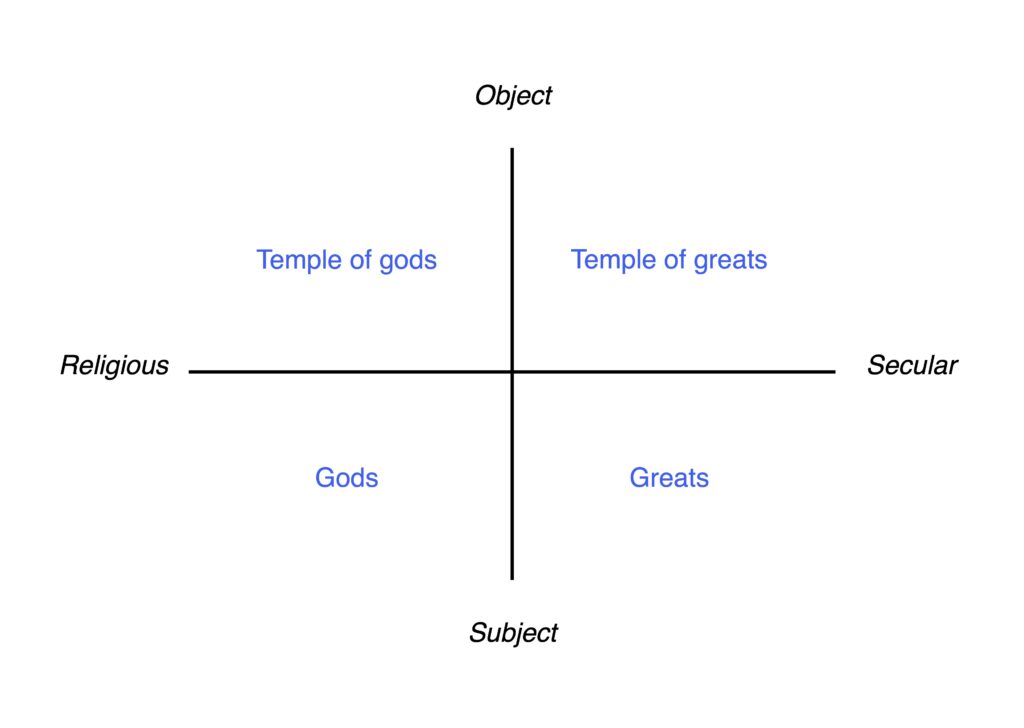
What actually is a pantheon? The original Greek word is composed of the words pân ‘all’ and theîon ‘divine, of the gods’; thus, the word pantheon literally means ‘of all the gods’. The history of the term’s use is complex, but in modern usage it mainly refers to two things: a) a temple dedicated to (all) the gods of a community (e.g., the Roman pantheon) or b) the gods of a community or people (e.g., the Mesopotamian, Roman, Greek, Norse, and Slavic pantheons). In its secondary, somewhat figurative and secularized meaning, however, the term pantheon no longer refers to a group of deities, but to a group of famous people. Here too, it can refer to either a) an object in which great personalities of a community are buried or glorified in the form of monuments (e.g., the Lisbon Pantheon), or b) a group of important or famous personalities (e.g., the pantheon of Italian painters, the pantheon of American film legends, etc.). Thus, the semantic range of the word primarily lies at the intersection between a pantheon as an object (a site) or a subject (a group of deities) versus a pantheon as a religious or secular category (Figure 1).
Pantheons are changing: as MIT’s online Pantheon shows, in the twenty-first century saints, kings, artists, and inventors are increasingly being replaced by soccer players, ice hockey players, singers, and film actors. The proposed project aims to shed light on the historical process that has led to such digital transformations of the pantheon idea by focusing on a historically specific and in many ways pioneering form of pantheon: the national pantheon. The national type of pantheon was stimulated by the spread of national thought and took root in very different forms, especially in the course of the nineteenth century and in the first decades of the twentieth century, first in Europe and shortly thereafter in the United States, the Caucasus, Asia, and elsewhere.
As new imagined communities, nations needed heroes that could be ritually worshipped in prestigious places. As part of these efforts, the protagonists of the national movements promoted a new type of hero, the so-called cultural saints, and also drew other personality types that were already the object of veneration (religious leaders, rulers, warlords, and heroes, but also travelers and inventors) into the national commemorative framework. They imagined such a whole as a pantheon of the nation’s “great men” (women were extremely rare), which, by materializing in a concrete space, offered the emerging national cult a prestigious lieu de mémoire. In pantheons, the impulses of nation (the rise of national movements), commemoration (the spread of commemorative cults), and sacralization (the aspects of nationalism as a secular religion) were particularly intensely intertwined.
European national pantheons
The European pantheonic imagination was most strongly inspired by four representative examples: the Roman Pantheon, whose complex history in antiquity, the Middle Ages, and the early modern period provides an important key to understanding the further development of pantheons; the (revolutionary) Pantheon of Paris, which emerged after the secularization of Saint Geneviève’s Church as a republican temple for the burial and veneration of outstanding French citizens; Westminster Abbey in London, where the mortal remains of numerous monarchs, presidents, and military leaders as well as artists (the “Poets’ Corner”) are kept; and finally the neoclassical Walhalla near Regensburg, where a new uniform type of temple was created that dispenses with the idea of housing the relics of pantheonized personalities.
The four major examples that have received the most attention so far significantly shaped pantheonic solutions in Europe in the long nineteenth century—but by no means exhaustively. Among the prominent remaining examples are Madrid’s Pantheon of Illustrious Men (El Panteón de Hombres Ilustres), Lisbon’s National Pantheon (Panteão Nacional), based in part on the French model, Holy Cross Basilica (Basilica di Santa Croce) in Florence, which has established itself over the centuries as the burial place of great Italian artists and scientists, Wawel Cathedral in Krakow, where Polish kings and heroes rest alongside national poets, and the Pantheon of Illustrious Galicians (Panteón de Galegos Ilustres) in Saint Dominic of Bonaval Church (Iglesia de San Domingos de Bonaval) in Santiago de Compostela.
In a slightly different way, the pantheonic idea materialized in pantheon cemeteries, which were gradually transformed into national pantheons through the concentration and transfer of monuments and relics as well as architectural interventions (arcades and avenues): Budapest’s Kerepesi Cemetery, Helsinki’s Hietaniemi Cemetery with its burial mounds for writers and presidents, Barcelona’s Montjuïc Cemetery, Prague’s Vyšehrad Cemetery with its monumental Slavín collective tomb, Zagreb’s Mirogoj Cemetery with its Arcade of National Awakeners, Belgrade’s Novo Groblje Cemetery with its Avenue of the Great, and Ljubljana’s Navje Cemetery, designed by the architect Jože Plečnik as a Grove of Illustrious Men. The idea of a pantheon cemetery spread beyond Europe and had an impact well into the twentieth century (Georgia’s Mtatsminda pantheon above Tbilisi, the Komitas pantheon in Yerevan, Armenia, the “Zionist” pantheon on Mount Herzel in Israel, the uncompleted Icelandic pantheon in Þingvellir, etc.).
National pantheons—conceived either as temples or as cemeteries—were based on the ancient practice of burying and/or commemorating local greats in symbolically invested spaces and adapted them to the needs of modern national movements. They were conceived as secular pilgrimage sites in which people were to experience a deep connection with their nation and its glorious past through identification with pantheonized figures. The success of these realizations could fluctuate greatly because the pantheonic aspirations, in which conflicting interests often intersected, came up against constraints: sacred buildings were controlled by the church, which was not necessarily enthusiastic about promoting (secular) cults; the remodeling of cemeteries was costly and time-consuming; and different political principles (liberal vs. conservative) and ideas of social structure (republic vs. monarchy) clashed, as did the conflicting interests of pantheon promoters and builders.
However, the idea of the pantheon also functions at an imaginary level: nations as imagined communities create imaginary pantheons that exist in the collective imagination independently of whether the community of national deities can be honored by visiting a particular place. The imaginary pantheon, which was subordinated to the national principle at the end of the nineteenth century, can be thought of as a (Platonic) idea that can be realized in a temple, a cemetery, or in other ways—for example, in the form of a portrait gallery, an avenue of statues, the paintings of a national institution, or even a collection of books. Particularly interesting from this point of view are sculptural pantheons placed in representative national institutions, squares, or parks (e.g., the recent ambitious project Skopje 2014) or concentrated in a single gigantic sculpture (e.g., Tysyacheletiye Rossii ‘Millennium of Russia’ in Novgorod).
The colorful and complex European pantheon network outlined above has not yet been treated comparatively and synthetically. Therefore, one of the major aims of the project is to survey the individual national pantheons, to analyze and classify them comparatively, and to develop a theoretical model for further comparative studies. Building on this, selected examples and aspects of European national pantheons will be examined in greater detail, with a focus on material pantheons. In particular, the members of the project team will examine in depth (including the study of primary archival and empirical material) those cases for which they have sufficient linguistic and cultural knowledge (the former Habsburg lands and the territory of the former Yugoslavia, as well as Italy, France, Germany, and the United Kingdom). At the same time, one of the main objectives of the project will be to identify and build a network of competent researchers across Europe.
Methodology
The central starting point of the project—namely, that modern secular nationalisms need pantheons as pre-modern religious institutions—harbors certain hazards and at the same time promises a valuable scholarly contribution. This already characterizes the methodological starting point of the project. When we attempt to empirically record national pantheons in their various forms, we are faced with challenging methodological dilemmas. The first is the following: What is to be considered a national pantheon in the first place—when we know that the process of pantheonization precedes nationalism and that there are therefore pantheons that can hardly be called national? Here the project will use their initiators and, above all, their promoters and sponsors as the decisive criterion: We can only call those pantheons national that were inspired by national thought in the broadest sense, and especially those that were planned and promoted by the protagonists of national movements. A further dilemma arises in the (frequent) cases in which attempts to create pantheons have remained fragmentary and incomplete. Here, the analysis of material pantheons, which will be the focus of the project, will be complemented by the consideration of other forms of pantheons (sculptural, pictorial, and discursive) and by the inclusion of additional factors (public monuments, rituals, book production, and school curricula) in the interpretation.
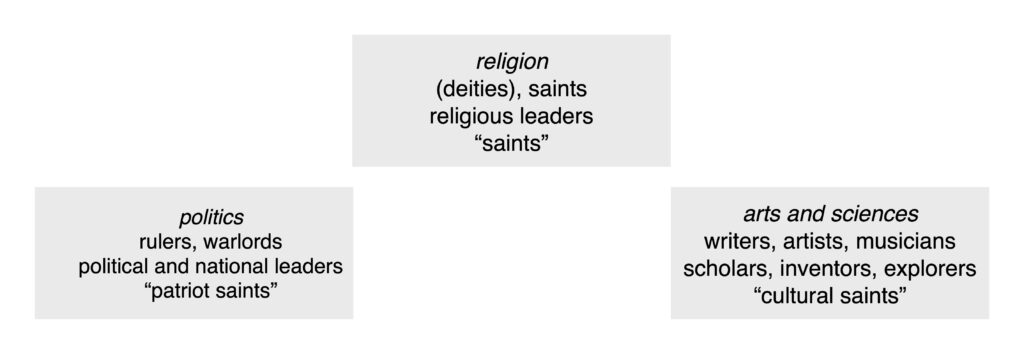
As for the structure of the national pantheons, they are dominated by personalities from three main areas: religion, politics, and arts and sciences. The first group—the one we call “saints”—includes prophets, saints, religious leaders, and reformers: it has always been the subject of religious commemoration, and national movements have often adapted such traditions and incorporated them into their specific framework. At the same time, the range of political figures in the national context has expanded. Kings and generals were joined by political and national leaders or revolutionaries; this political type can be described as “patriotic saints.” Finally, the national movements gave rise to a third, relatively new type of “deity,” which can be described as “cultural saints”: poets, writers, artists, composers, scholars, inventors, andexplorers. Although the patriotic type is best represented by the figure of the “father of the nation,” the cultural type is most vividly embodied by the figure of the “national poet,” well known in many, especially smaller, national movements (Figure 2).
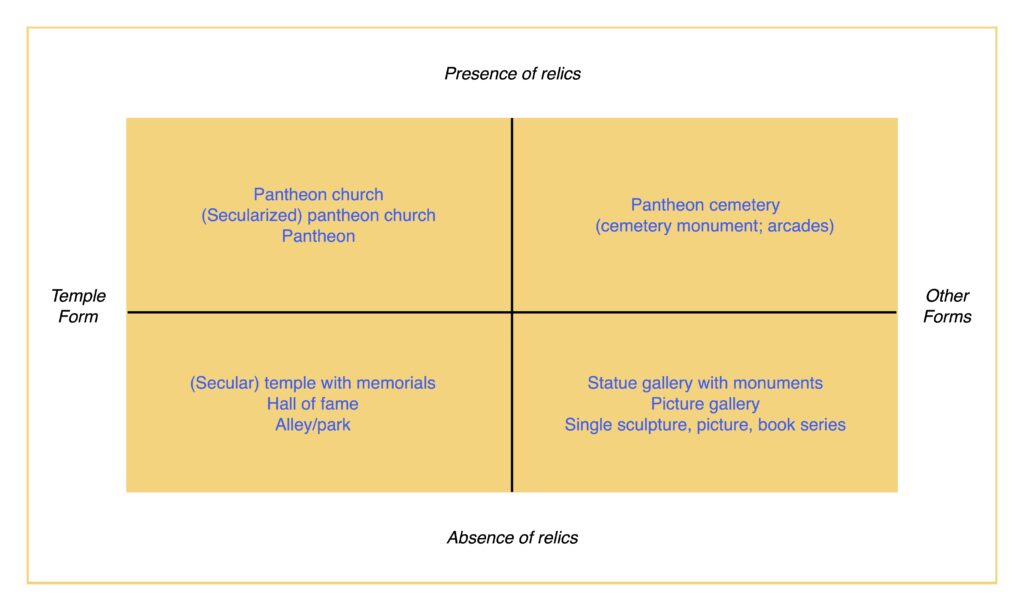
As far as form is concerned, the typology of national pantheons, as manifested in their various materializations, can be outlined by means of two distinctions. The first concerns the presence or absence of the mortal remains of the pantheonized figures, and the second the form of realization, ranging from the (architectural) temple on one side to a series of other forms that do not mimic the temple form. This results in four quadrants that the existing pantheonic configurations can be classified into (Figure 3).
The methodological starting points outlined above raise a number of questions that can only be adequately answered in a comparative manner. To what extent is the structure of national pantheons variable: to what extent does it vary across time and space? Are there specific differences, for example, between northern and southern Europe, and between Catholic, Protestant, and Orthodox cultures? What differences are there between the large nations, where national movements could draw on rich monarchical and imperialist traditions, and the small, subordinate nations, where political emancipation overtook the nationalist process? How did the process of creating pantheons relate to the political emancipation of the smaller European nations, especially those where the political process had not yet been completed? How did the European multinational empires (e.g., the Habsburg Empire) react to the processes of pantheonization? How can traces of appropriation conflicts be recognized in the pantheons, in which a certain personality is appropriated by several actors? How and when did women enter national pantheons? Are pantheons structured in an egalitarian way—that is, do the deities in the pantheon have at least approximately the same significance, such as the Greek Olympian Twelve (dōdekátheon) or the five gods of the Norse pantheon (Æsir)—or is worship concentrated on individual, prominent deities, such as the father of the nation or the national poet? In other words, are the national pantheons monotheistic or polytheistic? What kind of saints predominate: patriotic or cultural? Finally, what is the degree of sacralization—are there significant differences in the way individual national movements incorporate rituals and other religious elements into the commemoration of their pantheon? What relationships have developed between increasingly secular states and local religious institutions in this regard?These are all large and complex questions that can only be adequately answered through interdisciplinary and comparative research that goes beyond the domain of individual disciplines and combines the methods of general and cultural history, comparative literature, art history, memory studies, nationalism, and religious studies.